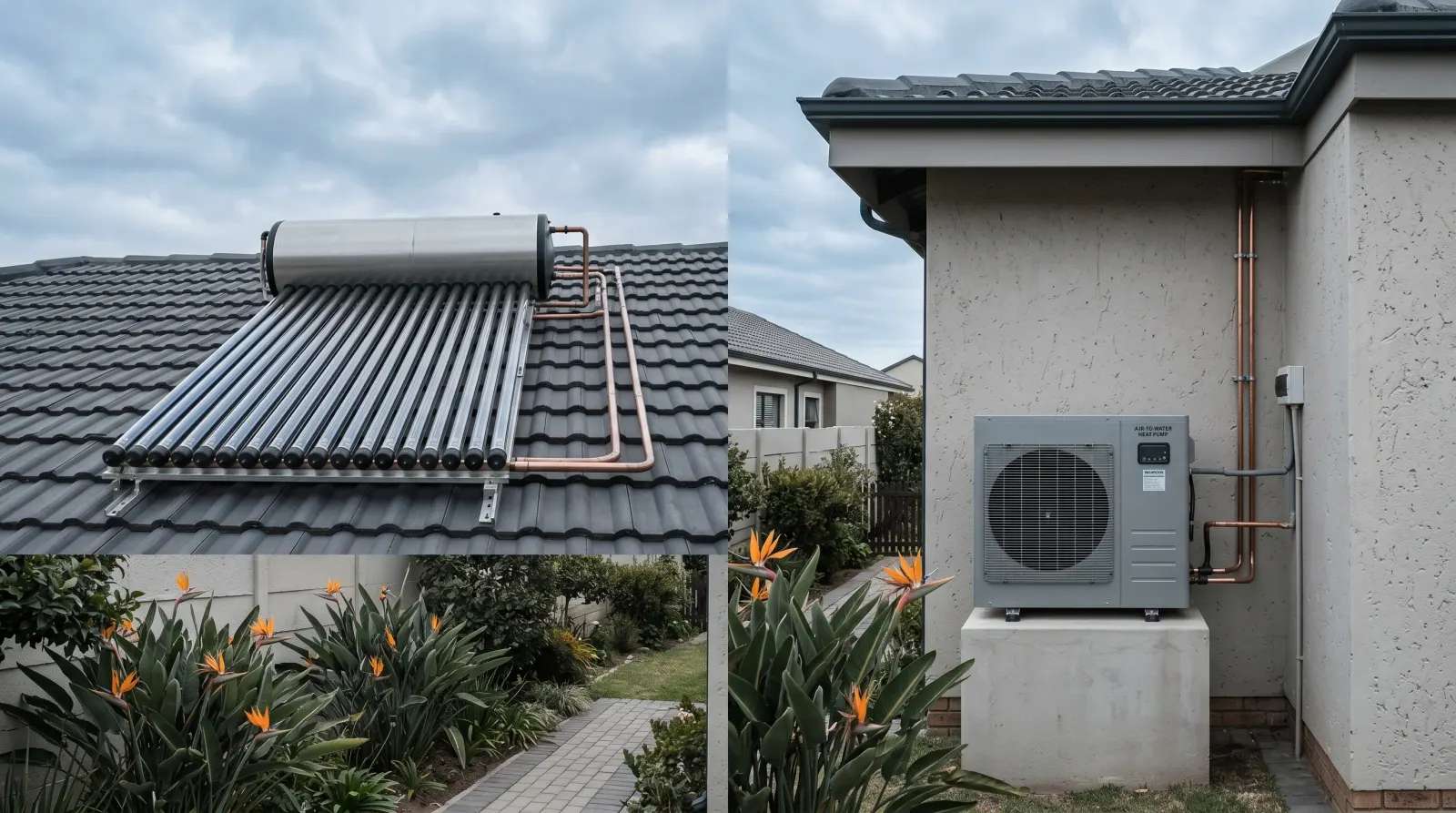
A solar geyser is the cheaper one to run for most South African homes: about R279-R338 a month against R327-R396 for a heat pump on a 200L tank. Retrofitted to your existing geyser the two cost about the same to buy (R26,900 solar, R27,298 heat pump), and over ten years come to roughly R60,380-R67,460 against R66,540-R74,820. A heat pump is cheaper overall only when roof space or winter sun is limited. Choosing between the two comes down to your home's specific setup - whether you have north-facing roof space for solar collectors, whether you're already on solar PV, and what your priority is between long-term running cost and all-weather reliability. This 2026 guide compares both technologies from a home-suitability angle: solar panel owners vs non-owners, roof space vs no roof space, sunny coastal regions vs cloudy inland climates. Find out which water heating solution actually suits your property - not just which looks cheaper on paper. For how a solar geyser itself works, see our complete solar geyser guide, or see our solar geysers for sale with installed prices by size.
Updated 27 November 2026. Table prices are retrofits onto your existing 200L geyser, checked 26 November 2026: our catalogue solar retrofit, and our ITS 3.6kW heat pump bundle (geyser up to 200L, no new tank). A new solar system with its own tank is R29,500-R42,500 (EnergyBee installer-panel quotes, 27 October 2026). Running costs are units a month x R3.44-R4.17 a unit (2026/27, incl. VAT), using our assumed units: on a 200L tank 324 electric, 81 solar backup and 95 heat pump; on a 150L tank 279 electric, 70 solar backup and 81 heat pump (solar backup is 25% of electric, the heat pump about 29%). The figures here are the 200L ones; the ten-year figure is the 200L installed price plus 120 months of running cost, with no tariff increases and no maintenance. Our solar geyser cost guide prices a new 200L system and adds maintenance, so its solar total (R68,980-R93,060) is higher.
Which is cheaper: a heat pump or a solar geyser?
Cheaper to run: the solar geyser, on a sunny north-facing roof. To buy: about the same on a retrofit. Fitted to your existing 200L geyser the heat pump is about R400 more to install and about R48-R58 more a month in electricity, but it heats in any weather and needs no roof space, which makes it the better choice for the homes that cannot fit or fully use collectors.
| Cost (200L system) | Solar geyser | Heat pump |
|---|---|---|
| Retrofit on existing geyser, installed | R26,900 | R27,298 |
| Running cost per month | R279 - R338 | R327 - R396 |
| 10-year cost (retrofit + running) | R60,380 - R67,460 | R66,540 - R74,820 |
Retrofit onto an existing 200L geyser, South Africa 2026. Source: EnergyBee catalogue and ITS 3.6kW bundle (26 November 2026); running cost at our assumed units x R3.44-R4.17.
Heat pump geysers offer the best balance of upfront cost and long-term savings for most South African homes - especially those already on solar PV or in cloudy coastal regions. Our installed estimate for an ITS heat pump is R27.5k-R40.5k (150L to 200L+, tank not confirmed), with payback set by the quote, your tariff and your hot water use.
Solar geysers cost less to run, and less over ten years on a like-for-like retrofit, but require north-facing roof space and a backup element - making heat pumps the smarter choice when roof space is limited or you want all-weather reliability.
Not sure which is right for your home?
We help you compare quotes for both a solar geyser and a heat pump, so you can compare real prices for your home - free, no obligation.
Heat Pump Geyser vs Solar Geyser - Installed Price Comparison
| Factor | Heat Pump Geyser | Solar Geyser |
|---|---|---|
| Installed Cost | R27,298 (retrofit, up to 200L, no tank); R27,500 - R40,500 (our ITS installed estimate, 150L to 200L+; tank not confirmed) | R24,036 (150L retrofit); R26,900 (200L retrofit); R29,500 - R42,500 (200L new system) |
| Monthly Running Cost | R327 - R396 | R279 - R338 (backup only) |
| Payback Period | Not modelled | Not modelled |
| Works on Cloudy Days? | Yes - all weather | Backup element needed |
| Roof Space Required? | No | 6-8 m² north-facing |
| Lifespan | 10-15 years | 20+ years |
| Best For | All climates, solar PV homes, limited roof space | Long-term savings, sunny regions |
Which suits your home: solar geyser or heat pump?
Two questions, no contact details. We match your household to one of the two and show a sized price from this page: a retrofit price if you are replacing a geyser for up to 4 people, otherwise the quoted range for the size.
Full Three-Way Comparison Overview
| Factor | Solar Geyser | Heat Pump | Gas Geyser |
|---|---|---|---|
| Upfront Cost | R25,500 - R42,500 (150-200L) | R27,500 - R59,500 (150-300L) | R8,000 - R18,000 |
| Monthly Running Cost | R279 - R338 (backup element) | R327 - R396 | R400 - R700 |
| Efficiency | 85-95% | 200-400% | 80-95% |
| Payback Period | Not modelled | Not modelled | Not modelled |
| Lifespan | 20+ years | 10-15 years | 10-15 years |
| Best For | Long-term savings, eco-conscious | Cloudy climates, quick ROI | Off-grid, instant hot water |
2026 Installed Cost Comparison: Heat Pump Geyser vs Solar Geyser
Installed price (supply + installation, VAT inclusive) for a standard 200L residential system in South Africa as of mid-2026:
| Cost Item | Heat Pump Geyser | Solar Geyser |
|---|---|---|
| Retrofit on existing geyser (200L) | R27,298 | R26,900 |
| Quoted installed range | R27,500 - R40,500 (our ITS installed estimate, 150L to 200L+; tank not confirmed) | R29,500 - R42,500 (200L, new system) |
| Monthly Running Cost | R327 - R396 | R279 - R338 (backup only) |
| Payback Period | Not modelled | Not modelled |
| Lifespan | 10 - 15 years | 20+ years |
2026 price note: Heat pump geyser prices have stabilised following improved local supply. Solar geyser installed costs include a SESSA-certified installer and council-approved bracket system. Get a current quote to confirm pricing for your property.
Caveats: figures on this page are typical 2026 South African ranges, not a quote - actual installed price, running cost and payback depend on your tariff, household hot-water use, roof type and the installer you choose. Compare quotes for your own numbers before deciding.
Understanding Each Water Heating Option
What is a Solar Geyser?
A solar geyser (also called a solar water heater or solar hot water heater) uses solar collector panels mounted on your roof to capture the sun's heat and transfer it to water stored in an insulated tank. This solar powered water heater system can provide 70-90% of your hot water needs using free solar energy.
How it works:
- Solar collectors absorb heat from sunlight
- Heat is transferred to water via direct circulation or heat exchange fluid
- Hot water is stored in an insulated tank
- Backup electric element provides heating on cloudy days
- System operates passively (thermosiphon) or with a circulation pump
What is a Heat Pump Geyser?
A heat pump (or heat pump geyser) uses electricity to extract heat from the surrounding air and transfer it to water. Think of it as a reverse air conditioner for your geyser. Heat pumps are 3-4 times more efficient than traditional electric geysers because they move heat rather than generate it.
How it works:
- Fan draws ambient air over evaporator coils
- Refrigerant absorbs heat from air and vaporizes
- Compressor increases pressure and temperature of refrigerant
- Hot refrigerant transfers heat to water via heat exchanger
- Process repeats continuously while unit operates
What is a Gas Geyser?
A gas geyser (tankless or instantaneous water heater) uses LPG (liquefied petroleum gas) to heat water on demand as it flows through the unit. Unlike tank systems, gas geysers provide endless hot water without storing heated water, making them space-efficient and eliminating standby heat loss.
How it works:
- Cold water flows through heat exchanger when tap opens
- Flow sensor detects water movement and ignites gas burner
- Gas flame heats water instantly as it passes through
- Temperature adjusts based on flow rate and gas input
- Unit shuts off automatically when tap closes
Get Personalized Recommendations
EnergyBee's AI analyzes your household size, water usage patterns, location, and budget to recommend the optimal water heating solution. Compare solar geyser prices, heat pump costs, and gas geyser options with personalized calculations.
Get Your Free Water Heating Recommendation →Detailed Cost Analysis
Solar Geyser Prices and Total Cost of Ownership
Solar geyser prices vary significantly based on system type, size, and quality:
| System Type | Size | Price Range |
|---|---|---|
| Direct Thermosiphon (Budget) | 150L | R25,500 - R27,500 |
| Direct Thermosiphon (Quality) | 200L | R29,500 - R35,500 |
| Indirect/Pumped System | 200L | R35,500 - R42,500 |
| Flat Plate Collectors | 200-300L | R32,500 - R45,500 |
20-Year Total Cost of Ownership (200L system):
- Initial investment: R29,500-R42,500
- Running costs (backup element): R279-R338/month × 240 months = R66,960-R81,120
- Maintenance: R12,000-R20,000 (our assumption of R600-R1,000 a year, over 20 years)
- Total 20-year cost: R108,460-R143,620
Over 15 years, the period used for the heat pump below, the same basis comes to R88,720-R118,340 for solar.
Heat Pump Costs and Total Cost of Ownership
Heat pump pricing for residential installations:
| Brand/Type | Capacity | Price Range |
|---|---|---|
| 1-2 people, installed (price guide) | 100-150L | R27,500 - R44,500 |
| 3-4 people, installed (price guide) | 200L | R39,500 - R53,500 |
| 5+ people, installed (price guide) | 250-300L | R44,500 - R59,500 |
| ITS 3.6kW retrofit onto your existing geyser, installed, no new tank | Up to 200L | R27,298 |
The rows by size are from our heat pump geyser price guide, VAT included; whether a new tank is included differs by quote.
15-Year Total Cost of Ownership (200L system):
- Initial investment: R39,500-R53,500 (200L installed, from our heat pump price guide; whether a new tank is included differs by quote)
- Running costs (electricity): R327-R396/month × 180 months = R58,860-R71,280
- Maintenance: R12,000-R18,000 (our assumption of R800-R1,200 a year for coil cleaning and refrigerant checks, over 15 years)
- Total 15-year cost: R110,360-R142,780
Gas Geyser Prices and Total Cost of Ownership
Gas geyser prices for instantaneous systems:
| Type | Flow Rate | Price Range |
|---|---|---|
| Basic Instantaneous | 8-12L/min | R8,000 - R12,000 |
| Mid-Range (Dewhot, Paloma) | 12-16L/min | R12,000 - R15,000 |
| Premium/Condensing | 16-20L/min | R15,000 - R18,000 |
10-Year Total Cost of Ownership (12L/min system):
- Initial investment: R13,000
- Running costs (LPG gas): R400-R700/month × 120 months = R48,000-R84,000
- Maintenance: R6,000-R9,000 (our assumption of R600-R900 a year for servicing and safety checks, over 10 years)
- Total 10-year cost: R67,000-R106,000
Cost Comparison Insight
While solar geysers usually cost the most upfront as a new system, they offer the lowest long-term running costs. Heat pumps provide the best balance of initial investment and operating efficiency. Gas geysers have the lowest purchase price but highest ongoing fuel costs.
Which saves more per month: a heat pump or a solar geyser?
Compared to a 200L electric geyser costing about R1,115-R1,351 a month (324 units at R3.44-R4.17), here are the monthly savings on our assumed units (solar backup 81, heat pump 95; LPG 0.8-1 of a 19kg cylinder at R500-R700):
| System | Monthly Cost | Monthly Savings | Annual Savings |
|---|---|---|---|
| Standard Electric | R1,115 - R1,351 | - | - |
| Solar Geyser | R279 - R338 | R836 - R1,013 | R10,032 - R12,156 |
| Heat Pump | R327 - R396 | R788 - R955 | R9,456 - R11,460 |
| Gas Geyser | R400 - R700 | R651 - R715 | R7,812 - R8,580 |
Pros and Cons: Detailed Analysis
Solar Geyser Advantages and Disadvantages
Advantages
- • Lowest running cost on our basis (backup element only)
- • Longest lifespan (20+ years)
- • Highest environmental benefit (zero emissions)
- • Only the backup element draws electricity
- • Increases property value significantly
- • Municipal rebates available in some areas
- • Proven technology with minimal maintenance
Disadvantages
- • High upfront investment (R29,500-R42,500 for a new 200L system)
- • Weather dependent (needs backup on cloudy days)
- • Requires adequate roof space and orientation
- • Installation more complex than electric geyser
- • Needs a collector as well as a tank
- • Can be affected by hail or extreme weather
Heat Pump Advantages and Disadvantages
Advantages
- • 3-4x more efficient than electric geysers
- • Works in all weather conditions (even cloudy)
- • No roof collectors needed
- • Can run on solar power during the day
- • Moderate upfront cost (mid-range option)
- • Quieter operation than older models
- • Suitable for areas with limited roof space
Disadvantages
- • Still requires electricity to operate
- • Slower hot water recovery than gas
- • Performance drops in very cold weather (<5°C)
- • Mechanical parts can fail (compressor, fan)
- • Requires outdoor installation space
- • Shorter lifespan than solar (10-15 years)
- • Can be noisy (fan and compressor noise)
Gas Geyser Advantages and Disadvantages
Advantages
- • Lowest initial purchase price
- • Endless hot water supply (no tank limits)
- • Instant hot water (no waiting)
- • Space-saving (no large tank needed)
- • No standby heat loss
- • Works during load shedding (no electricity)
- • Quick installation
Disadvantages
- • Highest ongoing running costs (gas prices)
- • Requires LPG supply and storage
- • Lower flow rate than tank systems
- • Cannot supply multiple taps simultaneously well
- • Complex installation (gas lines, ventilation)
- • Safety concerns (gas leaks, carbon monoxide)
- • Temperature can fluctuate during use
Which Option is Best for You?
The ideal water heating solution depends on your specific circumstances. Here's our recommendation framework:
Choose a Solar Geyser If:
- You have adequate north-facing roof space (6-8m²)
- You're planning to stay in your home long-term (5+ years)
- You want the lowest long-term operating costs
- Environmental impact is a priority
- You live in a sunny region (Western Cape, Northern Cape, Gauteng)
- You can afford the higher upfront investment
- You want to maximize property value
Choose a Heat Pump If:
- You want a balance of upfront cost and efficiency
- Your roof space is limited or unsuitable for solar collectors
- You live in a cloudy or coastal region (KZN coast, Eastern Cape)
- You have solar panels and want to run it on solar power
- You do not want collectors on the roof
- All-weather performance is important
- You prefer a more compact installation
Choose a Gas Geyser If:
- You're on a tight budget (lowest upfront cost)
- You live in an area with frequent load shedding
- You need instant, endless hot water
- Space is extremely limited (no room for tank)
- You're renting or in temporary accommodation
- You have easy access to LPG supply
- Initial cost is more important than running costs
Installation Considerations
Solar Geyser Installation Requirements
- Roof space: 6-8m² of north-facing roof (±30° orientation acceptable)
- Roof strength: Able to support 200-300kg additional weight
- Professional installation: SESSA-certified installer required
- Permits: May require municipal approval in some areas
- Installation time: 1-2 days for complete installation
- Backup element: Electric element required for cloudy days
Heat Pump Installation Requirements
- Outdoor space: 1-2m² for heat pump unit (wall or ground mounted)
- Ventilation: Adequate airflow around unit (1m clearance)
- Noise consideration: Away from bedrooms and neighbor boundaries
- Electrical supply: Dedicated circuit for heat pump
- Professional installation: Licensed plumber and electrician
- Installation time: 4-8 hours
Gas Geyser Installation Requirements
- Gas supply: LPG cylinder storage area (outdoors, ventilated)
- Ventilation: Proper exhaust ventilation (flue system)
- Location: Close to main hot water usage points
- Gas line: Copper piping from cylinder to geyser
- Professional installation: Registered gas installer required
- Installation time: 3-6 hours
- Compliance: Certificate of Compliance for gas installation
Maintenance Requirements and Costs
| System | Maintenance Required | Frequency | Annual Cost (our assumption) |
|---|---|---|---|
| Solar Geyser | Collector cleaning, pressure check | Annual | R600-R1,000 |
| Heat Pump | Coil cleaning, refrigerant check | Annual | R800-R1,200 |
| Gas Geyser | Burner cleaning, safety check | Annual | R600-R900 |
Environmental Impact Comparison
For environmentally-conscious homeowners, here's how each system compares:
- Solar Geyser: Zero emissions during operation, 90-95% renewable energy. Carbon footprint only from manufacturing and backup element use.
- Heat Pump: Reduced emissions (75-80% less than electric), still requires grid electricity. Carbon footprint depends on electricity source.
- Gas Geyser: Direct CO₂ emissions from LPG combustion. Lower carbon than coal-generated electricity but higher than renewables.
Annual CO₂ Emissions (200L system, 4-person household):
- Standard electric geyser: ~2,200 kg CO₂/year
- Solar geyser: ~200 kg CO₂/year (backup only)
- Heat pump: ~550 kg CO₂/year
- Gas geyser: ~800 kg CO₂/year
Combining Solutions: Hybrid Approach
For ultimate efficiency and reliability, some homeowners combine systems:
Solar + Gas Backup
Use solar geyser as primary system with gas geyser for instant hot water on cloudy days or high-demand situations. Provides maximum savings with excellent reliability.
Heat Pump + Solar Power
Run your heat pump on solar power during the day. When combined with a home solar system, this can provide nearly free hot water with all-weather reliability.
Get a Solar Geyser Quote
Get an installed solar geyser price for your home. Free, no obligation.
Get Solar Geyser Quotes →Get a Heat Pump Geyser Quote
Get an installed heat pump geyser price. See your ROI and payback period.
Get Heat Pump Quotes →Frequently Asked Questions
Is a heat pump geyser or solar geyser better for South Africa?
Both are excellent upgrades. On a retrofit onto your existing 200L geyser the two cost about the same to buy: R26,900 for solar and R27,298 for a 3.6kW heat pump. Heat pumps work at night and on cloudy days, and deliver 60-75% electricity savings. Solar geysers have near-zero running costs on sunny days and a longer lifespan (20+ years). In sunny coastal regions like Cape Town, a solar geyser can outperform a heat pump economically. In Gauteng with frequent winter cloud cover, heat pumps often deliver more consistent savings.
What is the installed cost of a heat pump geyser vs solar geyser in South Africa?
Heat pump geyser installed costs in South Africa: R27,500 for a 150L system to about R40,500 at 200L and up (our installed estimate for an ITS heat pump, tank not confirmed), and R44,500-R59,500 for 250-300L in our price guide. Solar geyser installed costs: R25,500-R34,500 for 150L, R29,500-R42,500 for 200L and R32,000-R50,000 for a 300L split system. Check whether a quote includes a new tank or reuses your existing geyser before you compare, because that makes direct price comparison complex. Payback depends on the installed price, your tariff and how much hot water you use: divide the price by a year of savings.
Which saves more money - heat pump or solar geyser?
Solar geysers save more in sunny regions: up to 80-90% of water heating electricity in Cape Town or the Northern Cape. Heat pumps deliver more consistent savings (60-75%) year-round regardless of cloud cover. For Gauteng homeowners, a heat pump is often the smarter financial choice. For Cape Town and coastal homeowners with an unshaded north-facing roof, a solar geyser delivers better long-term value.
Does a heat pump or solar geyser work during load shedding?
Solar geysers continue heating water during load shedding because the sun heats the water directly - no electricity is needed during the day. The backup electric element won't work during outages, but solar heating alone is sufficient most days. Heat pumps require electricity to run the compressor, so they stop working during load shedding. For load shedding resilience, solar geysers have a clear advantage.
How long do heat pump geysers and solar geysers last in South Africa?
Solar geysers last 15-25 years for the collector (with minimal maintenance) and 8-15 years for the tank. Heat pump geysers last 10-15 years for the full system. From a longevity perspective, a quality solar geyser offers superior total value over its lifetime - especially with the low ongoing maintenance requirements of simple thermosiphon systems.
Heat pump vs solar geyser: which is cheaper in South Africa?
A solar geyser is cheaper to run, and on a like-for-like retrofit the two cost about the same to buy. Fitted to your existing 200L geyser in 2026, solar is R26,900 and a 3.6kW heat pump R27,298; solar then costs about R279-R338 a month in backup electricity and the heat pump about R327-R396. Over ten years at today's tariff that is roughly R60,380-R67,460 for the solar geyser against R66,540-R74,820 for the heat pump (price plus electricity, maintenance not included). The heat pump wins when the roof cannot take 6-8m² of north-facing collectors, when winter cloud is heavy (much of Gauteng and the KZN coast), or when you already have solar PV to run it on - then it is the cheaper all-weather option. Retrofit prices checked 26 November 2026; running costs are our assumed units (solar backup 81, heat pump 95 a month) at R3.44-R4.17 a unit.
How much does a heat pump geyser cost in South Africa?
A heat pump geyser costs R27,500-R59,500 installed in South Africa in 2026 for a 150L-300L system on our price guide (whether a new tank is included differs by quote), and our retrofit bundle for a geyser up to 200L is R27,298. That bundle fits a 3.6kW heat pump to the geyser you already have, with no new tank, so check whether any other quote includes one. Running cost for a 200L unit is about R327-R396 a month (our assumed 95 units at R3.44-R4.17) because the compressor uses about a third of the electricity of an element. See our heat pump geyser prices guide for the brand-by-brand breakdown.
What are the downsides of a solar geyser?
Four real ones. It needs 6-8m² of unshaded, roughly north-facing roof that can carry 200-300kg, which rules out some homes. Output drops on overcast days and in winter, so the backup element runs and your saving shrinks in the months you use the most hot water. The tank lasts 8-15 years against 15-25 for the collectors, so budget for one tank replacement over the life of the system. And a thermosiphon tank sits on the roof, which some homeowners dislike for looks or insurance reasons; a split system hides it but adds a pump and R3,500-R4,500 to the price. None of these makes a heat pump cheaper to run, but together they are why a heat pump suits limited roofs and cloudy regions.
Final Recommendation Summary
Best Choice by Priority:
Lowest Long-Term Cost: Solar Geyser
Best ROI over 15-20 years, especially in sunny regions. Lowest running cost on our basis.
Best Balance: Heat Pump
Moderate cost, excellent efficiency, works in all weather. Great for most households. Compare heat pump geyser models and prices →
Quick Solution: Gas Geyser
Lowest upfront cost, instant hot water, but highest running costs. Best for specific situations.
Ready to Choose Between a Heat Pump Geyser and Solar?
We help you compare quotes for both options, so you can compare real prices for your home. Free, no obligation.
Compare both quotes →